
What Is Evidence-Based Curriculum, and Why It Matters for Your Preschooler
If you have toured a preschool lately, you have probably heard the phrase “evidence-based curriculum” somewhere between the sign-in sheet and the cubbies. It sounds like something you are supposed to already understand, and it comes up right when you are also trying to notice whether the children look happy and whether the teacher knows everyone’s name.
In plain terms, an evidence-based curriculum is a teaching plan that has been studied, tested with real children, and shown to help them grow. It gives teachers a road map instead of leaving each day to chance. Below is what it means, what it actually looks like in a classroom, and the specific questions that will tell you what you need to know on a tour.
A quick tip from One Place: You do not need to memorize curriculum names. Ask one question instead: “What curriculum do you use, and how do you know it is working?” A strong program will have an easy answer to both halves.
What “evidence-based” actually means
A curriculum is a plan for what children learn and how teachers support that learning. It covers the daily routine, the materials on the shelves, how the room is arranged, what teachers say during play, and how progress gets tracked.
Evidence-based means researchers have studied that plan with real classrooms and real children, compared the results to classrooms not using it, and found that children gained something measurable. It rests on decades of research about how young children develop, especially in the first 2,000 days, roughly birth through kindergarten entry, when the brain builds its foundation faster than at any other point in life.
Good early childhood curricula are built around how young children actually learn, which is by doing, talking, building, and making a mess they then clean up. Worksheets and drilling sit outside that picture, and a strong preschool will tell you so directly.
Good to know: Researchers point out that no single curriculum covers every area of learning perfectly, so many strong programs combine a comprehensive curriculum with focused approaches in areas like language or early math. That combination is the mark of a thoughtful program.
What it looks like in a real classroom
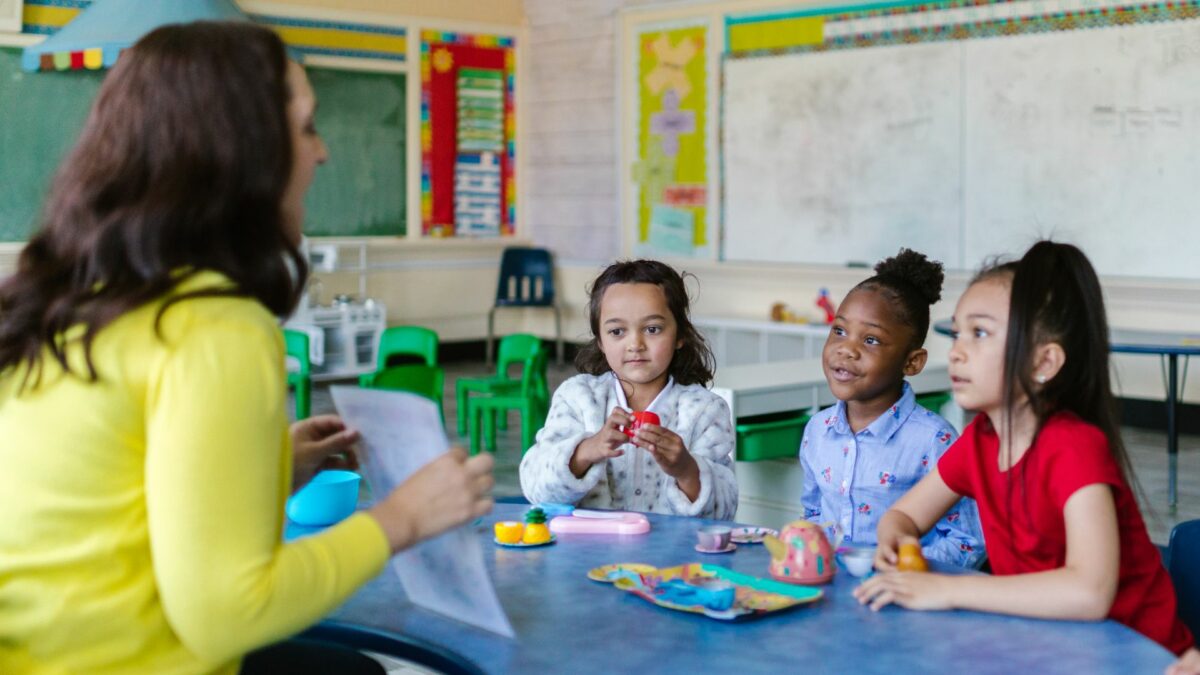
Here is where the term stops being abstract. In a classroom using a well-implemented curriculum, you should be able to see:
A predictable rhythm. Children know what comes next. Arrival, greeting, choice time, small group, outside, story, rest. That predictability gives children a sense of security, and it frees them to focus on learning.
Learning centers with a purpose. Blocks, dramatic play, art, books, sand and water, science. Each area is stocked deliberately and refreshed as children’s interests change.
Teachers talking with children. Open-ended questions. Narration of what a child is doing. Vocabulary that stretches a little past where the child is now.
Study topics that go deep. Many curricula run multi-week studies, on buildings, or trees, or balls, where children investigate one thing thoroughly instead of changing themes every week.
Documentation on the walls. Photos of children working, dictated quotes, samples of drawings and writing. This is how a classroom shows its thinking.
How teachers know it is working
The other half of an evidence-based approach is assessment, and in early childhood that word is gentler than it sounds. Preschool assessment happens through observation, gathered over time, in the ordinary course of the day.
A teacher watching your child stack blocks is noticing counting, balance, persistence, and whether your child invites a friend to help. Those observations get recorded, sorted against developmental objectives, and turned into a picture of where your child is and what to offer next.
What you should get from it: Regular updates. A conference where someone can describe your specific child, not just the class. A sense of what they are working on and what you might do at home.
Good to know: At One Place, our preschool programs and Early Head Start use Creative Curriculum along with its observational assessment system, Teaching Strategies GOLD.
Creative Curriculum is organized around 38 objectives for development and learning, spanning social-emotional skills, physical development, language, cognitive skills, literacy, mathematics, science, social studies, and the arts, and it aligns with North Carolina’s early learning guidelines and the Head Start Early Learning Outcomes Framework.
How this connects to North Carolina’s star rated license
Curriculum is one thread in a bigger fabric, and North Carolina gives parents a shortcut for reading the whole cloth.
Every licensed child care center and family child care home in the state carries a star rated license, from one to five stars, issued by the Division of Child Development and Early Education. One star means the program meets North Carolina’s minimum health, safety, and licensing standards. Programs that voluntarily meet higher standards can earn two through five stars, based on staff education and program standards, which includes classroom observation, materials, space, and teacher-to-child ratios.
Where to find it: The license is posted where families can see it, usually near the entrance. If you do not spot it, it is completely reasonable to ask.
Worth knowing: North Carolina has been modernizing its quality rating system, so the pathways programs use to earn stars may look different than they did a few years ago. Ask the program directly what their current rating is and when it was last assessed.
Religious-sponsored programs operate under a notice of compliance and do not carry a star rating unless they choose to apply for one. That simply means this particular measure will not be available, so you will want to ask more questions about curriculum and teacher qualifications directly.
Nine questions to ask on your tour
Print these, screenshot them, or keep them in your notes app.
- What curriculum do you use, and how long have you used it?
- How are teachers trained and supported in using it?
- How do you track each child’s progress, and how often will I hear about mine?
- What does a typical day look like from drop-off to pickup?
- How much of the day is child-chosen versus teacher-directed?
- How much time do children spend outside?
- What is your current star rating, and when was it last assessed?
- What are your teacher-to-child ratios in my child’s age group?
- How do you handle big feelings and conflicts between children?
Good to know: Watch the room while you ask. The answers matter, and so does whether children are engaged, whether teachers are down at child height, and whether the space feels calm.
Enrolling around orders and report dates
Two things make the search different for Marine Corps families here.
Timing. Enrollment windows do not always line up with report dates. Call as soon as you have orders rather than waiting until you arrive, and ask about waiting lists and mid-year openings.
Fee assistance. Military Child Care in Your Neighborhood, MCCYN, helps eligible families offset the cost of off-base care at participating providers. Program requirements change, so confirm current eligibility and provider participation before you commit to a program.
Continuity. If your child was in a Creative Curriculum classroom at your last duty station, ask whether the new program uses the same one. Familiar routines and materials smooth a transition that is already asking a lot of a small person.
Free help finding the right fit in Onslow County
You do not have to sort this out alone, and this is exactly what we do.
Child care referral: One Place maintains information on licensed programs across Onslow County and can help you build a short list that fits your child’s age, your schedule, and your part of the county. Start at our child care page or call 910-938-0336.
Our own preschool programs: One Place serves more than 700 children annually through preschool and Early Head Start programs. If your child turns three or four by August 31, it is time to look at applying. Details are on our preschool programs page.
Infant and toddler programs: For younger children, see our infant and toddler programs.
Getting ready for the first day: Once you have chosen a program, our guide on preparing your toddler for preschool covers the weeks leading up to it.
Independent research: The What Works Clearinghouse, run by the U.S. Department of Education’s Institute of Education Sciences, publishes reviews of early childhood curricula and interventions at ies.ed.gov/ncee/wwc. It is free, government-run, and useful if you like reading the studies yourself.
Frequently asked questions
What does evidence-based curriculum mean in preschool?
It means the program follows a teaching plan that has been studied with real children and shown to support their development.
Is Creative Curriculum the only evidence-based option?
No. It is one of the most widely used comprehensive curricula, and several others have research behind them as well. What matters most is that the program uses a researched curriculum and implements it well.
Does a five-star license mean the curriculum is good?
The star rating reflects staff education and program standards, which correlate with quality. It does not name a curriculum, so ask about that separately.
Should my preschooler be learning letters and numbers?
Yes, and through play, songs, stories, blocks, and conversation. Early math and literacy belong in preschool, embedded in things children actually want to do.
How do I find licensed programs in Onslow County?
Call One Place at 910-938-0336 for referral help, or visit our child care page for the current list of options.
What if I cannot afford the program I want?
Ask about subsidy, NC Pre-K eligibility, and MCCYN fee assistance for military families. One Place can walk you through what your family may qualify for.
Why this matters
The years before kindergarten are when a child builds the equipment they will use for everything after. Persistence through a hard task. Recovery when something goes wrong. The nerve to ask for help. A sense of belonging in a group. A good curriculum gives teachers a reliable way to notice each child and offer the next right thing at the moment that child is ready for it, and none of that requires trading play for academics.
Those same conditions build resilience. A child who spends their days with adults who know them well, in a place that runs predictably, with materials that invite them to try, is growing sturdier alongside their vocabulary. Choosing carefully now is one of the most durable gifts you can hand your child, and Onslow County has good options once you know what to look for.
We’re Here to Help
One Place is here for Onslow County families with child care referrals, preschool and Early Head Start programs, early learning support, and family resources, all in one place. Call us at 910-938-0336 with any question, big or small, or browse our family resources page.
Follow along on Facebook and Instagram, and tell us what questions you asked on your tour. Other parents in this county are asking the same ones.
Ready to take the next step? Call 910-938-0336 and let us help you build your short list.
Want to help every child in Onslow County thrive? Your gift supports safe care, early learning, and hope for local families. Donate today.