
Yes, Your Child Is Learning Through Play. Here’s How.
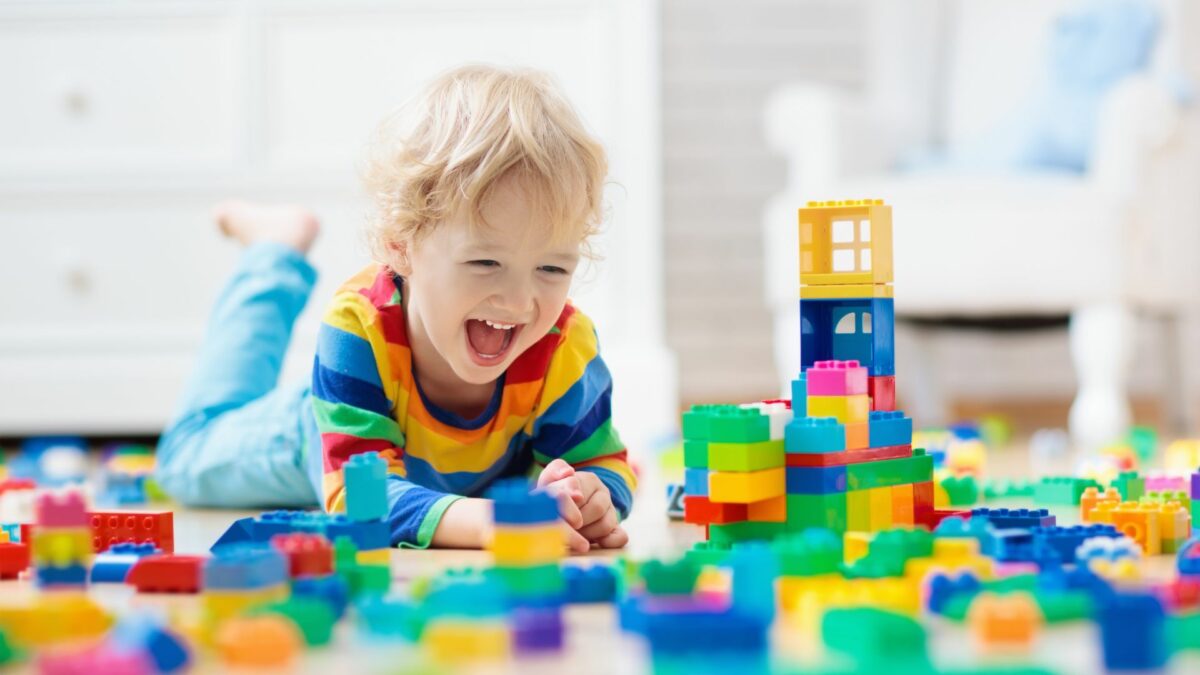
Walk into a preschool classroom in Onslow County and you will find children building, pouring, painting, and negotiating who gets to be the dog. It looks like a good time, and it is. It is also the most efficient learning your child will do all year.
Play is how young brains build. This guide covers what your child is actually practicing while they play, 10 kinds of play worth having at home, the questions that turn ordinary play into conversation, and free places around the county to do it.
A quick tip from One Place: Try narrating instead of directing. “You put the long block on the bottom” tells your child you are paying attention and hands them vocabulary at the same time. It takes no extra time and changes the whole exchange.
What play actually is
Play is child-initiated, child-directed, and open-ended. It is about the process rather than the product, which is why a tower built and knocked down 11 times counts as a productive afternoon.
Play belongs to your child. They decide what happens next, with you nearby, interested, and willing to follow. That ownership is what makes the learning stick.
What your child is learning while they play
Problem-solving. Play invites divergent thinking, which means finding several solutions to one challenge rather than the single right answer. A bridge that keeps collapsing is a genuine engineering problem, and your child is running the experiment.
Imagination and confidence. Pretend play builds creativity, and creativity builds nerve. A child who can invent a story can also invent a way through a hard moment.
Language. Play generates more talk than almost anything else in a child’s day, and talk is where vocabulary comes from.
Self-regulation. Taking turns, waiting, losing a game, and starting over are all practice for managing big feelings. This is real work, and it is exhausting for a four-year-old.
Physical development. Climbing, balancing, cutting, pouring, and threading beads build the large and small muscles your child needs for everything from soccer to handwriting.
Math, literacy, and science. A pretend grocery store involves counting, sorting, money, and signs. A bathtub involves volume, floating, and cause and effect. None of it needs to be labeled as a lesson.
Ten kinds of play, and how to do each at home
Creative Curriculum, which One Place preschool programs and Early Head Start use, organizes classroom learning around 10 core kinds of play. Each one has a simple home version.
One. Dramatic play. Make-believe builds collaboration, problem-solving, and abstract thinking. At home, keep a bin of props: hats, scarves, an old phone, plastic dishes. A cardboard box from the commissary run becomes a boat, a rocket, or a drive-through.
Two. Blocks. Deceptively simple, and excellent for early math and language. Take an interest in what your child builds and ask them to explain it.
Three. Manipulatives and games. Puzzles, small construction sets, board games, and collections of objects strengthen fine motor skills and cooperation. Sit down and play too rather than supervising from the couch.
Four. Art. Crayons, paper, safety scissors, glue, and collage bits let children express ideas they do not yet have words for. Resist the urge to ask what it is.
Five. Sensory play. Sand and water are curriculum staples. A tub of water on the back steps with measuring cups, funnels, and plastic animals is a full afternoon. If you are near the coast, the beach at Onslow Beach or the sound side does this for free.
Six. Library and books. Reading together every day is the single highest-value habit on this list. Let your child hold the book, turn the pages, and tell you what they think happens next.
Seven. Music and movement. Singing and dancing support self-expression and get the wiggles out. Mix the genres. Beach music, gospel, country, classical, whatever fills your kitchen.
Eight. Cooking. Measuring, stirring, and counting build vocabulary, math, and science. It takes longer and makes a mess, and it is worth it.
Nine. Outdoors and gym. Walks, playgrounds, and yards. Ask your child to collect leaves or shells, then sort them by size or color and make a pattern.
Ten. Discovery and science. Bubbles in the dish water, a magnifying glass in the yard, watching a thunderstorm roll in off the water. Wonder out loud and let your child answer.
The magic words: open-ended questions
The fastest way to deepen play is to ask questions that cannot be answered with yes or no. Keep a handful in your pocket and use them anywhere.
For building and construction: How did you build that? Why does it stay standing? How could you make it taller? What else could you try?
For art: What can you tell me about this? How did you get the idea? What should we do with it next?
For pretend play: What are you cooking? How do you know when the baby is hungry? What should I be?
For sensory and science: What do you notice? What do you think will happen if you add more? How could we find out?
For sorting and counting: Which has more? How do you know? How are these the same, and how are they different?
Good to know: Silence works too. When your child is deeply absorbed, the best move is often to say nothing at all and let them stay there.
Free ways to play across Onslow County
Parks and playgrounds. Jacksonville and Onslow County maintain parks across the area, and they cost nothing. Our guide to outdoor places in Onslow County has the current list.
The library. Onslow County Public Library branches offer story times, free books, and a quiet place to be on a rainy Saturday.
Free books at home. Dolly Parton’s Imagination Library mails a free book each month to enrolled children from birth to age five. Details are on our literacy and Imagination Library page.
Your own backyard. Sticks, buckets, water, dirt, and a cardboard box outperform most things with a price tag.
Parenting classes and trainings. One Place runs trainings each month for parents and early educators. See the current schedule on our training and registration page.
When play looks worrying, and usually is not
They play the same thing over and over. Repetition is how young children master something. The 30th round of the same game is practice, and it is doing exactly what it should.
They play alone. Solitary play is a real developmental stage and a genuine skill. Children also move in and out of playing near others before playing with others, and all of it is normal.
They play something intense. Children sometimes act out things that worry them, including doctor visits, storms, or a parent leaving. This is how they process, and joining in gently helps more than redirecting.
They get frustrated. The struggle itself is where the learning happens. Wait a beat before you rescue, then offer the smallest help that gets them moving again.
Play during deployments and moves
Play does a particular job in a Marine Corps household.
During a deployment, you may notice your child playing out goodbyes, homecomings, or packing. Let it happen, and play along if invited. It is a healthy way for a small person to work something through.
During a PCS, familiar toys and familiar games are anchors. Keep a few favorites out of the shipment and in the car.
When a parent is away, simple rituals help. A bedtime story on a recorded video, a map on the wall, a countdown jar. These are play, and they are also connection.
Good to know: If your child’s play changes sharply and stays changed, or if you are seeing distress you cannot settle, call One Place at 910-938-0336. We can point you toward local support.
Frequently asked questions
How much should my preschooler play each day?
As much of the day as you can manage. In high-quality preschool classrooms, play is the primary way learning happens.
Is my child falling behind if they are not doing worksheets?
No. Early math and literacy belong in preschool, and they land better through blocks, stories, songs, and conversation.
Should I play with my child or let them play alone?
Both, on different days and at different moments. Follow their lead, join when invited, and step back when they are absorbed.
What toys are best for learning through play?
Open-ended ones. Blocks, art materials, dress-up items, containers, and things from the recycling bin, all of which can become many things.
Does screen time count as play?
Some interactive use can be worthwhile, and it works best alongside plenty of hands-on, child-directed play. Passive watching does a different job, since the screen makes the decisions.
Where can I enroll my child in preschool in Onslow County?
One Place administers three preschool programs at no cost to eligible families: North Carolina Pre-Kindergarten for four-year-olds, Three School for three-year-olds, and Early Head Start for children six weeks through age three. Details are on our preschool programs page.
Why play matters
The thing about play is that it is also time together. A child sitting on the floor with a parent who is interested in their tower is learning about blocks, and learning something bigger at the same time, which is that the adults in their life find them worth paying attention to. That belief lasts. It shows up years later as confidence, as willingness to try hard things, and as a child who will tell you when something is wrong.
Ten minutes on the floor is enough. Your child is noticing that you sat down at all.
We’re Here to Help
One Place is here for Onslow County families with preschool and Early Head Start programs, child care referrals, parenting classes, and family support, all in one place. Call us at 910-938-0336, or browse our family resources page.
Follow along on Facebook and Instagram, and tag us with what your family built this week. We would love to see it.
Ready to take the next step? Explore our preschool programs, all offered at no cost to eligible Onslow County families.
Want to help every child in Onslow County thrive? Your gift supports safe care, early learning, and hope for local families. Donate today.